Zero Existing Infrastructure
No system to migrate from. Every primitive — venue, slot, inquiry, booking — had to be defined before a single screen.
“India's venue industry ran on Excel and phone calls. We built the operating system it never had.”
Operating system for India's venue industry — inventory, bookings and revenue in one system.
Client
Boozno
My Role
Product Strategy & Experience Design
Timeline
Multi-phase
Fewer Booking Conflicts
Conversion Efficiency
End-to-End System
Project Context
02 / 12Overview
An operating system replacing Excel, WhatsApp and phone calls — built around how venues actually work.
The Core Problem
Venue operations ran on memory. Inventory lived in people, not systems. Conflicts and missed leads were routine.
The Brief
A category-defining SaaS for India's venue industry — standardising inventory, booking logic and revenue in one system.
Deliverables
Team
1 Product Strategy & Design Lead (Solo) · Boozno Founding Team · Engineering Partner
How Might We
How might we turn memory-based operations into a system teams trust without training?
How might we eliminate booking conflicts before they happen — without adding coordination overhead?
How might we let a venue operation scale bookings without scaling its team?
How might we model real operational complexity without surfacing it as UI friction?
Constraints
No system to migrate from. Every primitive — venue, slot, inquiry, booking — had to be defined before a single screen.
First-time software users. Complexity had to be modelled in the system, not surfaced as UI friction.
Post-COVID surge. The system had to ship in phases without losing coherence release-to-release.
Banquet halls, hotels, farmhouses across multiple cities. Decisions had to generalise across venue types.
The Challenge
03 / 12Low lead-to-booking conversion, revenue loss from overlaps, zero performance visibility — and an operation that couldn't scale beyond human bandwidth.
How Might We
How might we turn memory-based operations into a system teams trust without training?
What was broken
Research & Discovery
04 / 12Methods
Mapped the full operational reality with the founding team — how venues actually run before any system exists.
10+ sessions
Watched sales and ops staff navigate Excel, WhatsApp and calls to piece together availability. The chaos was the research.
Studied where existing venue tools and adjacent SaaS had failed to model real operational complexity.
Mapped the exact decision sequence in each workflow with managers, coordinators and ops heads.
12 venue staff
Key Findings
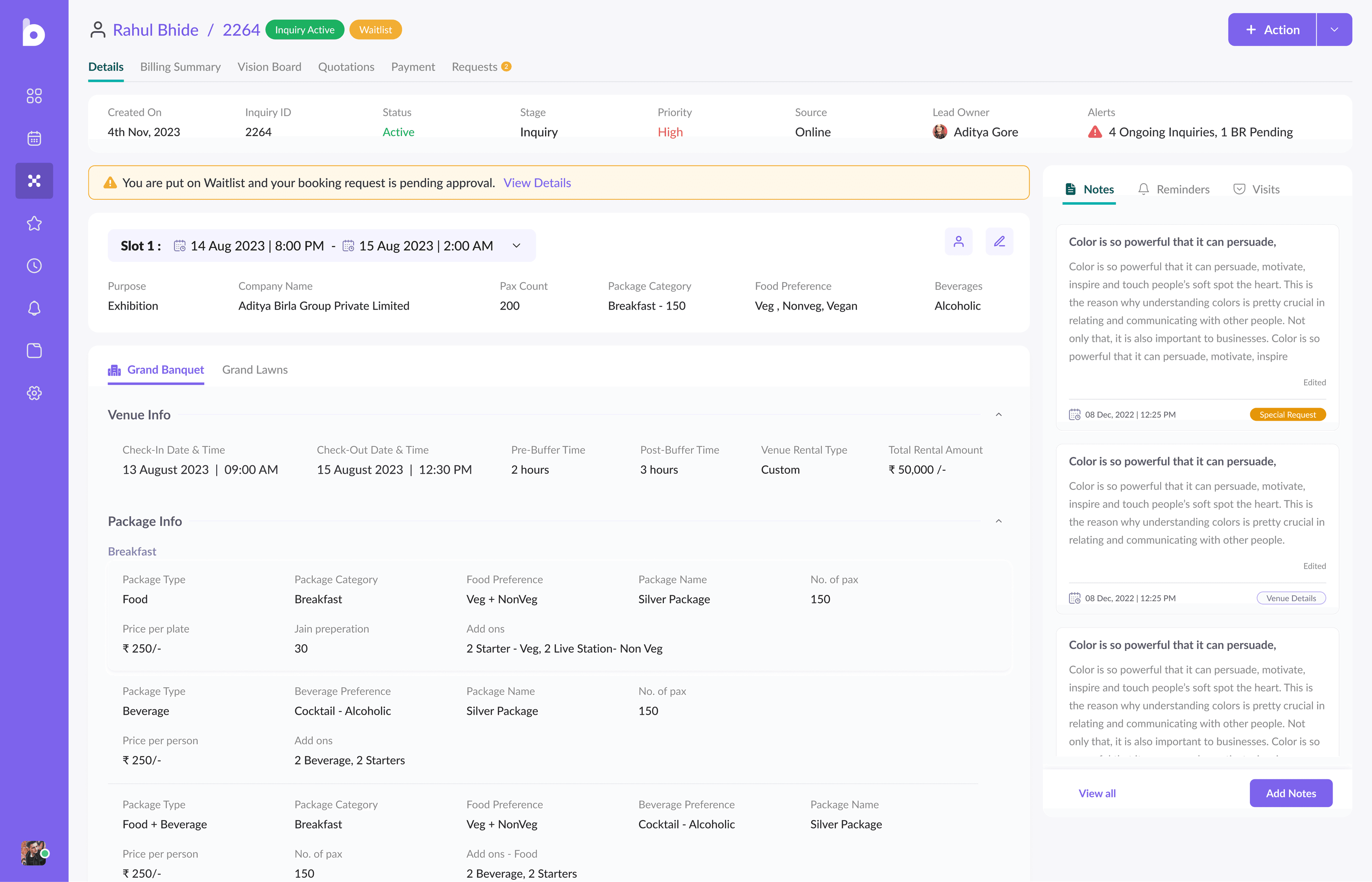
Venues don't lose bookings for lack of space — they lose them because time-bound sub-venue availability is invisible. The model had to be built around slots, not 'the venue.'
It wasn't lead quality — it was response time. The sales manager who can't confirm instantly loses to one who can.
Multiple staff quote overlapping slots before anything is confirmed. The conflict surface had to live at inquiry creation.
Information Architecture
Cross-system health — revenue, customers, prospects, employees
Account lifecycle — listing, business profile, venues, subscriptions
Plan catalogue with pricing, validity and feature mapping
Staff records, role-based access and onboarding URLs
Centralised reminders, alerts and team notifications
Account-level preferences for security and notifications
Static content — FAQs, terms, legal
User Personas
05 / 12Persona 01
Venue Sales Manager · 27
“I don't know what's available until I've called three people. By then, the client has moved on.”
Goal
Confirm availability in under five minutes — without leaving the inquiry screen.
Frustration
Availability lives across three systems and two people. She can never give a confident answer.
Behaviour
Keeps a personal notebook of bookings beside the official sheet — she doesn't fully trust either.
Persona 02
Venue Operations Head · 39
“I found out about the double-booking when both clients showed up on the same day.”
Goal
Zero conflicts — real-time visibility into every sub-venue slot.
Frustration
Three calendars, never in sync. He discovers conflicts after they've been promised.
Behaviour
Daily 9am WhatsApp round with every sales manager to manually compile availability.
Persona 03
Venue Owner / Director · 49
“I know we're leaving money on the table — I can't tell you how much or where.”
Goal
Real-time revenue, occupancy and team performance — without manual reports.
Frustration
Performance only visible at month-end when the team compiles a spreadsheet.
Behaviour
Decides on verbal weekly updates and gut feel — never live data.
User Flows
06 / 12Sales receives an inquiry. She creates it in Boozno — duplicate detection runs instantly. The 360° calendar shows live sub-venue availability. She sends a booking request with a 48-hour expiry. Client confirms. The slot blocks automatically. Pricing fires, quote generates, billing summary lands. Ops sees the booking live. The owner opens the dashboard the next morning and sees the revenue.
Core Flow · Booking Lifecycle
Inquiry → Confirmation → Revenue · the path the system was built around
Inquiry received
Lead
Phone, WhatsApp or walk-in
Qualify + dedupe
Instant
Structured fields gated at entry; auto-checked against open leads
360° calendar check
Real-time
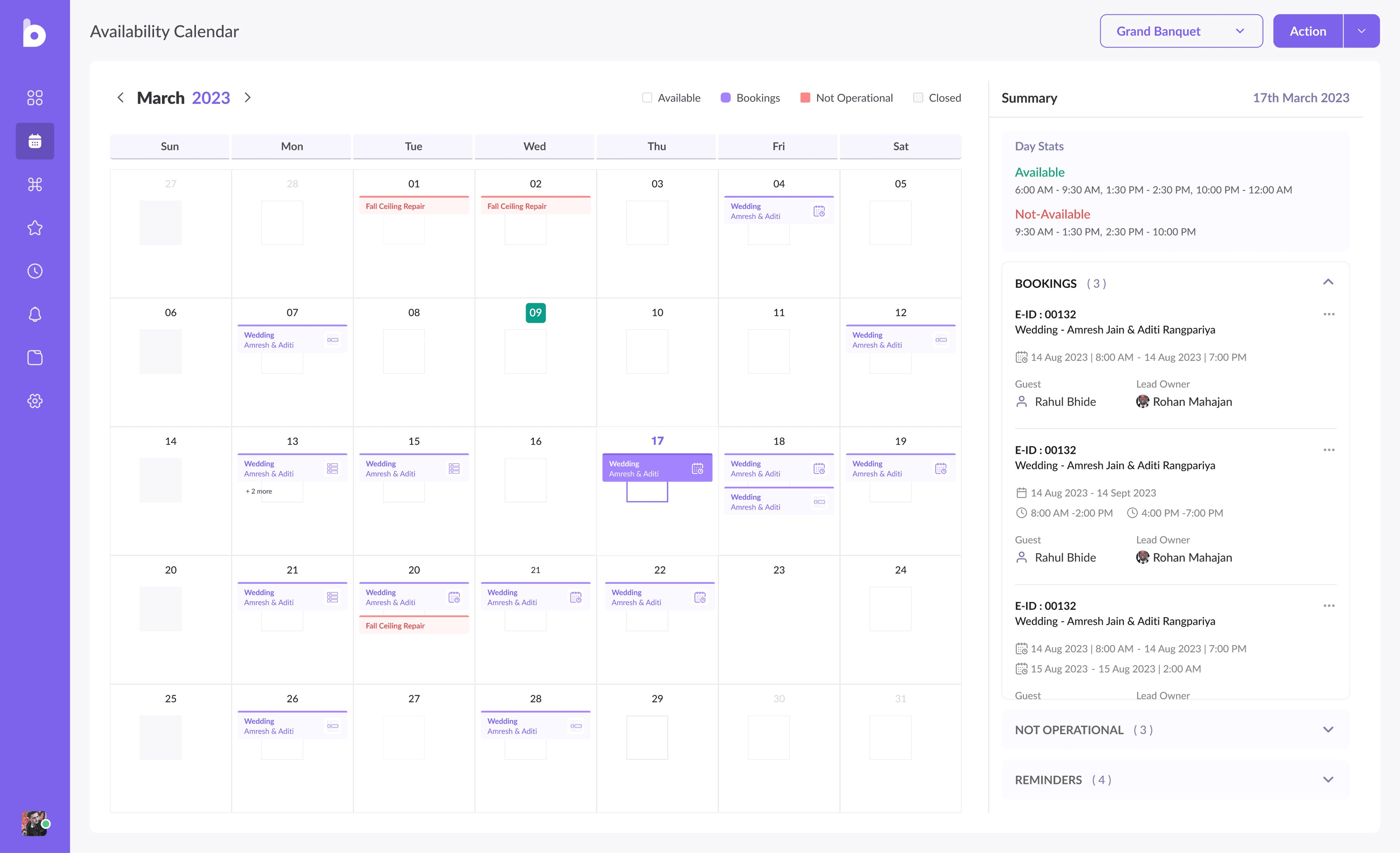
Live sub-venue availability — no callbacks, no Excel
If blocked → suggest alt slots / waitlist
Quote + booking request
Auto
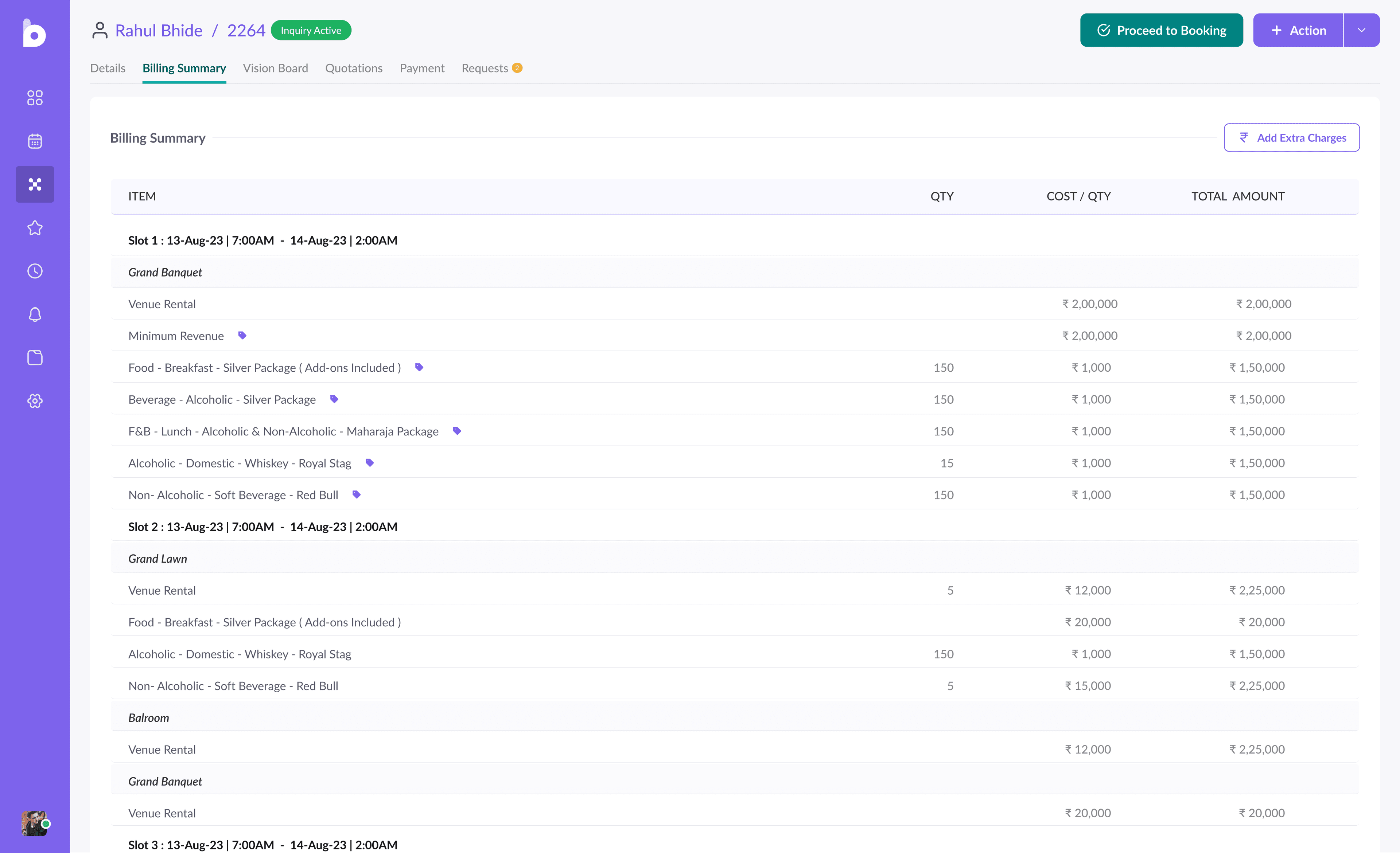
Pricing engine fires; quote generated with packages and add-ons
Client confirms
48h
Configurable expiry window — no phantom verbal holds
If expired → slot returns to availability
Auto-block + billing
Auto
Slot locks across the system; billing summary lands automatically
Live revenue
Live
Owner dashboard updates — no month-end reconciliation
01
Lead
Phone, WhatsApp or walk-in
02
Instant
Structured fields gated at entry; auto-checked against open leads
03
Real-time
Live sub-venue availability — no callbacks, no Excel
If blocked → suggest alt slots / waitlist
04
Auto
Pricing engine fires; quote generated with packages and add-ons
05
48h
Configurable expiry window — no phantom verbal holds
If expired → slot returns to availability
06
Auto
Slot locks across the system; billing summary lands automatically
07
Live
Owner dashboard updates — no month-end reconciliation
Journey Map · Emotional Arc
6 stages
Phone call · WhatsApp · Walk-in
“Are they real? Have I quoted this slot to anyone else?”
Capture lead with structured qualification + duplicate check at entry
Excel sheet · Ops team WhatsApp
“I need to confirm now — every minute, the lead is cooling.”
Live 360° calendar surfaced inside the inquiry screen — no leaving
Manual quote sheet · Calls back-and-forth
“Pricing varies by date, package and add-ons — every quote feels custom.”
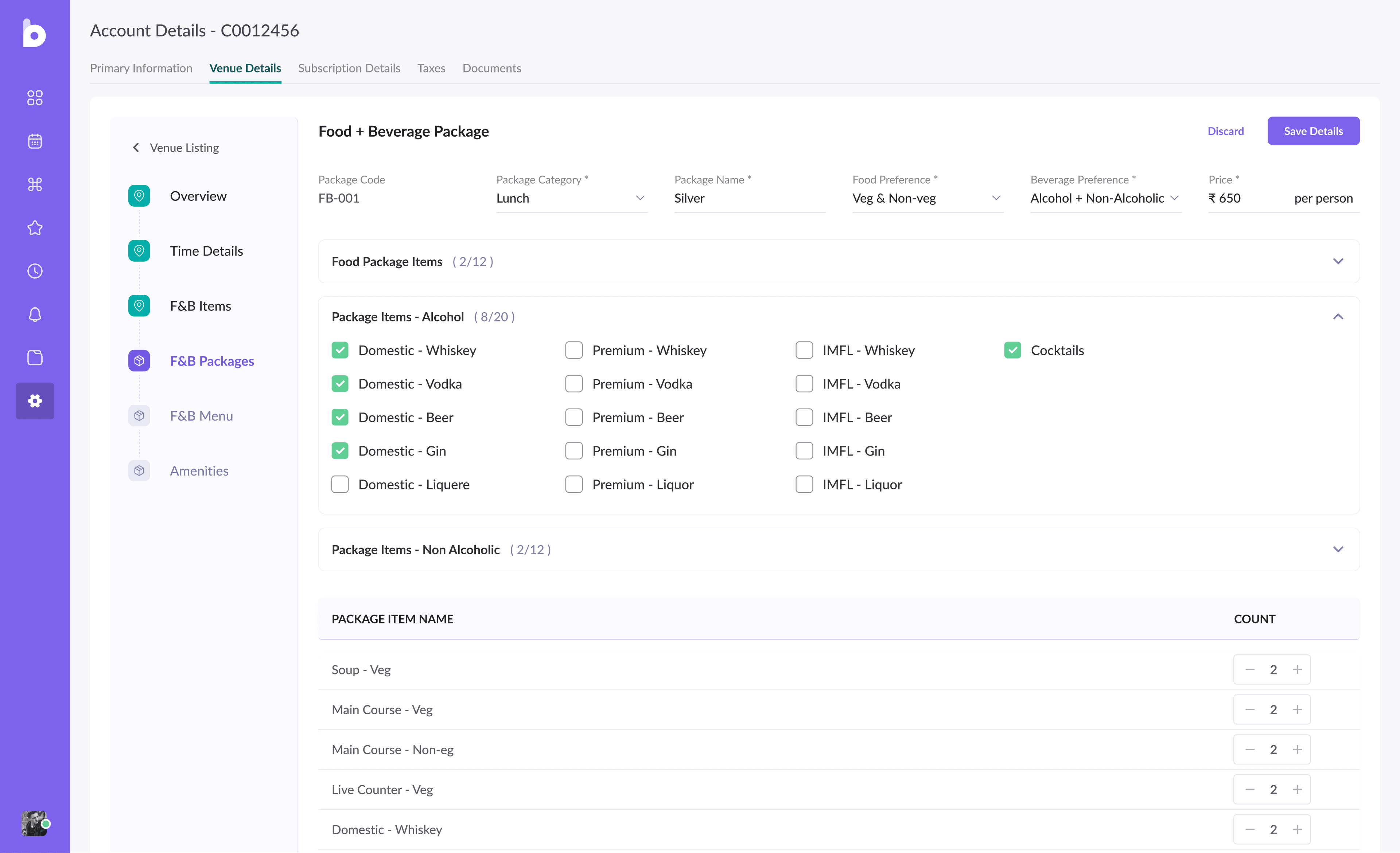
Pricing engine with packages, add-ons and per-booking overrides
Verbal hold · Tentative booking
“I want to lock the slot but the client hasn't fully committed.”
Booking request with configurable expiry — no phantom holds
Payment receipt · Ops handoff
“Did ops get this? Is the slot actually blocked everywhere?”
Auto-block on confirm, ops sees it live, billing summary generated
Month-end spreadsheet compilation
“I'm flying blind until the team puts the numbers together.”
Live dashboard with revenue, occupancy and team performance
Process
07 / 12Structure
Real-world operations modelled as primitives — venues, sub-venues, time, capacity, pricing.
Validate
Every interaction tested against constraints — capacity, time, pricing, real edge cases.
Control
Roles, approvals and states layered in — bookings and conflicts as first-class primitives.
Scale
One system, single hall to multi-venue chain — standardised by design.
Data Model
Core PrimitivesThe physical property a customer operates — banquet hall, hotel, farmhouse.
Attributes
An independently bookable space inside a venue — main hall, garden, terrace.
Attributes
A qualified lead with structured data — gated at entry, deduplicated automatically.
Attributes
A confirmed slot — request → expiry → confirm. Writes to the 360° calendar.
Attributes
Modelled before a single screen was designed — every primitive defined first, UI followed.
Design Decisions
08 / 12Every significant design decision was a deliberate choice with a rationale. Here are the ones that shaped the product most.
Context
Real venues operate as multiple bookable spaces — main hall, garden, terrace — not single units.
Choice
Hierarchical inventory: every Venue contains Sub-venues with independent capacity, availability and pricing. Every interaction lives at the sub-venue level.
Flattening complexity caused misbooking. Every shortcut in the data model became a user pain point at scale.
Impact
Eliminated the most common conflict class — overlapping bookings on multi-space venues treated as one unit.
Context
Availability lived in three places at once — sales head, ops sheet, WhatsApp group. Never the same, never current.
Choice
All time logic centralised. Inquiries, bookings, holds and blocks write to one calendar. No parallel tracking anywhere.
Make conflicts structurally impossible — don't try to catch them after the fact.
Impact
~65% fewer booking conflicts. Availability confirmed on the first call, from the inquiry screen.
Context
Venue deals span days of negotiation. Instant booking forced certainty venues couldn't deliver.
Choice
Request workflow with configurable expiry. Client confirms in time or the slot returns to availability.
Match the real sales cycle without creating availability dead zones from phantom holds.
Impact
Cut inventory lock-up from verbal holds. Gave sales a legitimate way to manage partial commitments.
Feature Design
09 / 12Each feature solves a specific problem surfaced in research. Here's what we built and why.

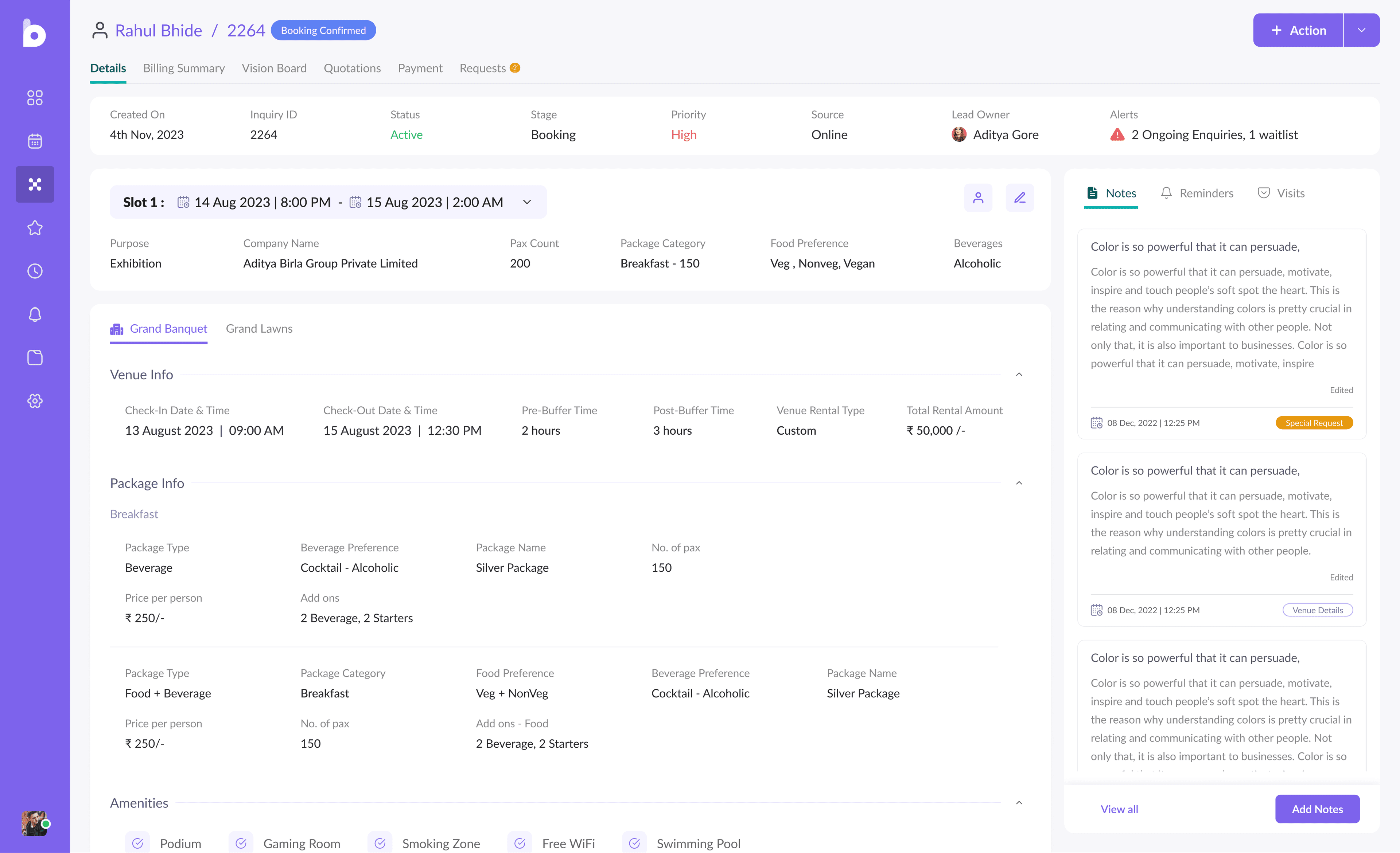
Venue → Sub-venue model. Multi-space complexity mapped cleanly. Every booking lives at the sub-venue level.
Note
The model reflects reality — every shortcut became a pain point

Inquiries, bookings, holds and blocks all write to one calendar. One source of truth for every availability answer.
Note
Conflicts become structurally impossible, not just less likely

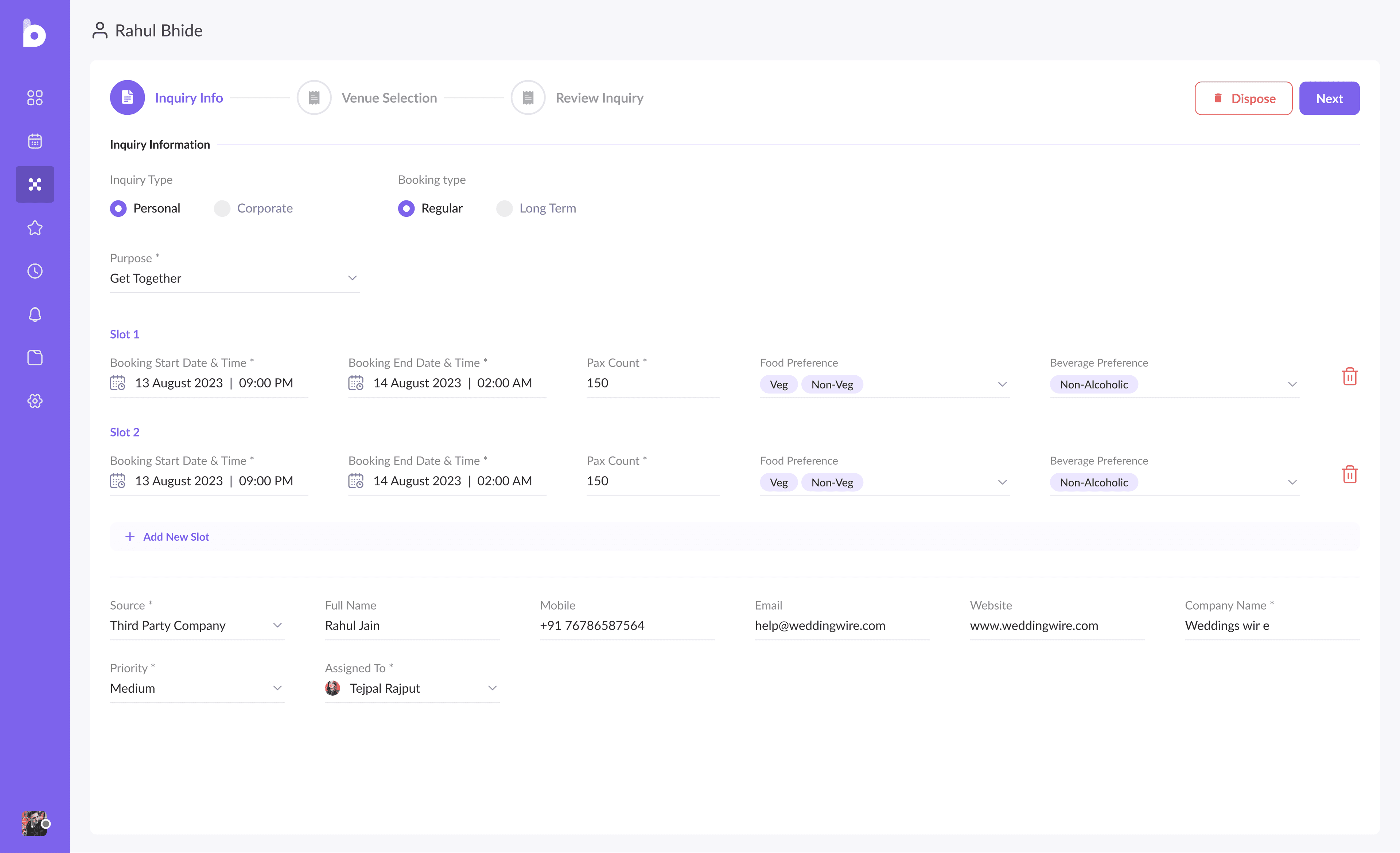
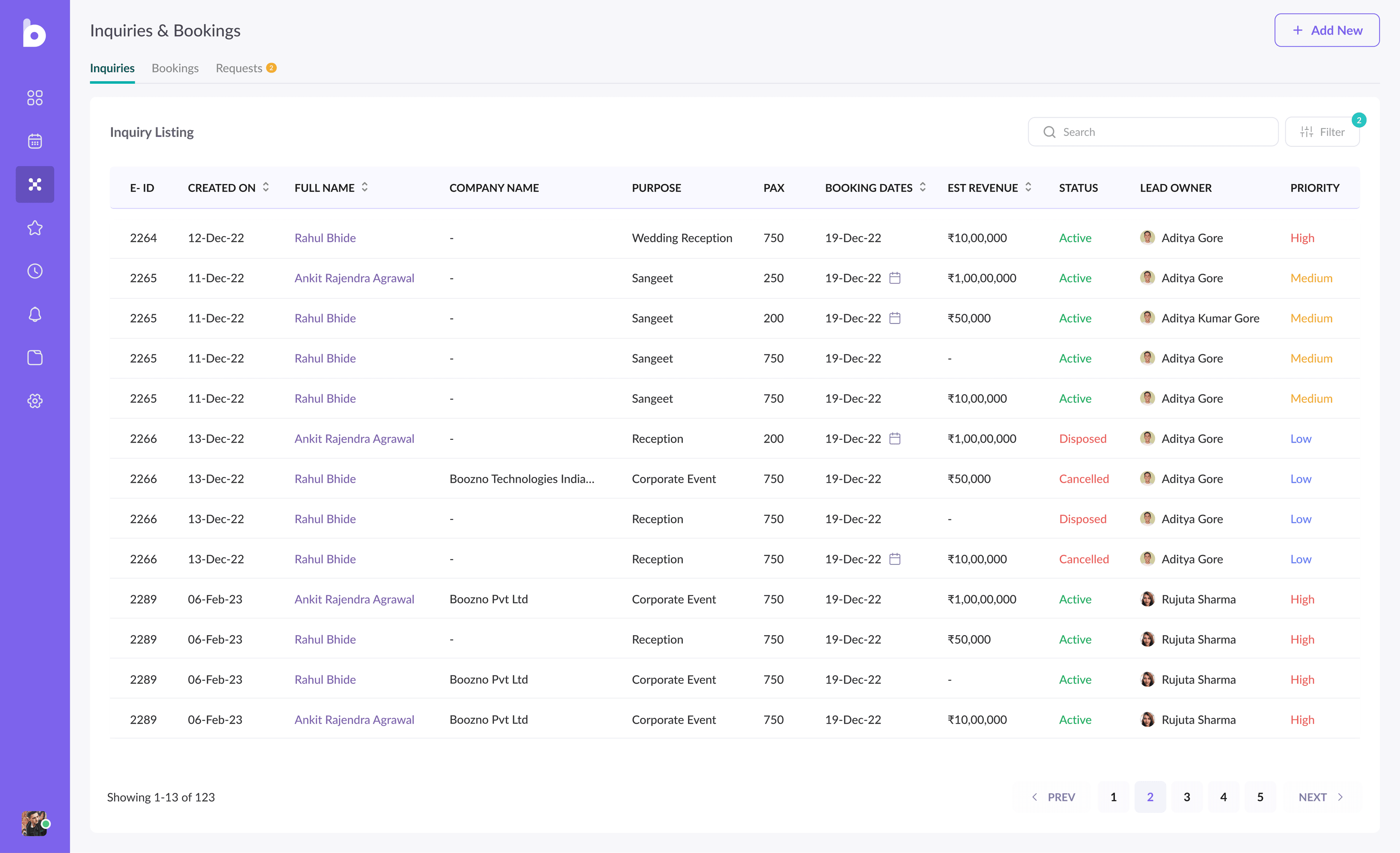
Qualification gated at entry — event type, date, guests, budget. Duplicate detection runs against existing leads automatically.
Note
Qualify at entry — unqualified leads were destroying conversion

Configurable expiry windows and a conflict-aware waitlist. Parallel inquiries for the same slot are structured, not dropped.
Note
The real sales cycle involves negotiation — the system reflects it

Packages, add-ons and per-booking overrides — full negotiation variability without manual quote sheets.
Note
Fixed pricing models failed — variability is the norm

Booking confirmation, billing summary and payment tracking — closing the loop from inquiry to revenue without leaving the system.
Note
The full lifecycle in one surface — no handoff to spreadsheets

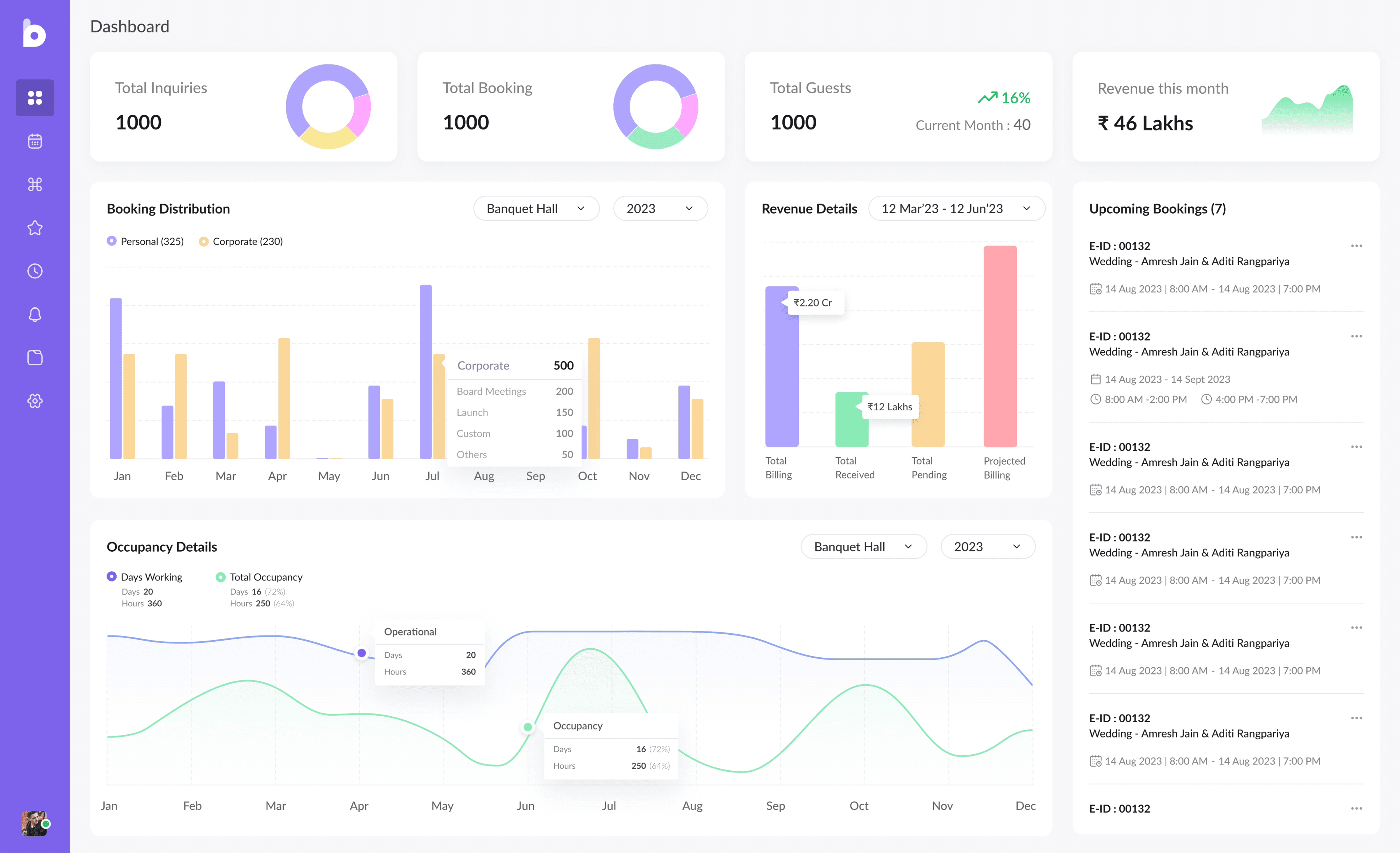
Revenue lifecycle, occupancy and team performance in one view. Visibility owners never had without manual compilation.
Note
The owner finally has a number, not just a feeling
Results
01 / 04
improvement in conversion efficiency
02 / 04
reduction in booking conflicts
03 / 04
Visibility
operational visibility across venues and teams
04 / 04
Sales velocity
shorter sales cycles, improved response times
Bluemint understood our business before they touched the design. The system they shipped reflects how venues actually run — not how software typically forces them to.
Ankit Agrawal
Founder & CEO
Reflection
11 / 12Key Learnings
Systems fail when they oversimplify reality. Every abstraction that didn't match how venues worked became a workaround — and workarounds become shadow systems that compete with the product.
In operational tools, control and clarity beat speed. Streamlining away friction that exists for a reason creates worse problems than it solves.
Adoption by non-technical users isn't a UI problem — it's a mental model problem. If the vocabulary is wrong, the interface is wrong, regardless of polish.
If I started again
Test with frontline sales staff in month one, not month three. The critical workflow nuances only surfaced when I watched staff work in real time.
Lasting impact
Boozno set my conviction that system design is the highest-leverage form of product design. Shape the data model and operational primitives first — UI second. Otherwise you've just digitised the chaos.
Where it landed
A unified SaaS for inventory, inquiries, bookings and revenue. +18–25% conversion efficiency. 65% fewer booking conflicts.
We take on a limited number of engagements at a time — enough to give each one the focus it deserves. If you're building in AI, fintech, enterprise SaaS, or GovTech and need a senior partner who can shape the strategy, design the experience, and help it ship — let's talk.
No commitment. No pitch deck. Just 30 minutes on your product. We respond within 24 hours.
India / Remote-first · Global partnerships